
For the next interview in the Dark Humor Books Interview Series, I’m excited to talk to A Lee Martinez. In our chat, Martinez shares some insights into humor as integral to plot and we find out the best TV show about the worst humans on earth.

A Lee Martinez is a powerhouse of witty plots, with a dozen novels published that feature monsters: witches, aliens, robots, zombies and even a Cyclops.
He’s already working on writing his fifteenth book and has sent his fourteenth out for publication. He describes the next novel as “Lady in the Lake meets Goodfellas. Kind of. If you’re looking for a book with Avalon, mob goons, cosmic dragons, many cans of SpaghettiOs, and a (possibly) evil chair, then this will be it.”
Interview with Novelist A Lee Martinez
KB: Is it more important to you that the scene you write is funny, or impactful?
AM: Being funny is never my primary goal. This is why, though I’m often labeled a comedic writer, I don’t consider myself one. There’s a lot of humor in my books though, so I don’t mind the label. It’s just how I write and how I make my voice distinct.
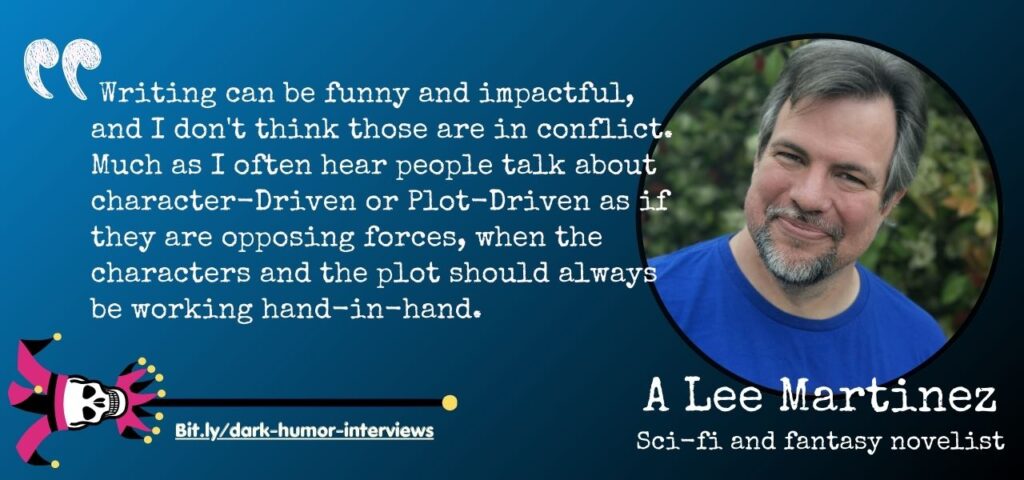
However, I think there’s a misconception in the question itself. Writing can be funny and impactful, and I don’t think those are in conflict. Much as I often hear people talk about character-driven or plot-driven as if they are opposing forces, when the characters and the plot should always be working hand-in-hand.
KB: For sure writing can be both funny and impactful, and dark humor can have a powerful impact. Years ago at the San Francisco Writers Conference I asked Christopher Moore how often he’d he edited out a joke because he wanted that scene to land on a more serious or touching note, and how he balanced that. He said he’d never sacrificed a joke, and I was so surprised.
AM: The humor in my stories isn’t a superfluous element, and I never want it to be conflict with the story itself. Good writing is about taking all those elements (and more) and making them work together.
KB: That’s really interesting. I think a lot of the humor in my writing is somewhat superfluous, like it comes through in dialogue which could have been written with the same subtext but no humor. But there have been moments where I want the reader to feel catharsis and if I make them laugh, that’s a different sort of release of tension. So I cut the funny bit because I don’t think the reader wants to laugh in that moment, that to go for the joke might even land as a cop-out from facing the thing full on. Then in the next scene I can offer that dark comic relief.
But one of the reasons Catch-22 captivated me is that, as you say, the grim humor is integral to the plot. And I think the same thing is true of another favorite, Everything Is Illuminated. I’d love to hear an example from your work, of plot-integral humor, if you can think of one that doesn’t give too much away!
AM: I’ll pick one of my more obscure books for indulgence. My novel Too Many Curses hinges on a particular bit of absurdist humor. The entire plot kicks off when an all-powerful wizard slips and falls, dying in the first chapter. Not really a spoiler.
The humor of the situation is intentional. It’s meant to make you laugh, take you by surprise, but also, it’s strongly character and story based. A central theme of the story is the importance of small tasks, embodied by the protagonist who is a housekeeper. An ironic element is that she even warns the wizard of the slippery stone, but, of course, he doesn’t listen because he doesn’t respect her. Which is another theme of the book.
The humor serves the story and its themes. That’s how I avoid making it disposable.
KB: How does dark humor work as a coping mechanism for you, or for your audience?
AM: Comedy generally is a coping mechanism. Although it’s also just a way I tend to process the world. Whether it’s silly or cynical, absurd or satirical, the world we live in is strange and confusing. I don’t relate to people who can’t laugh at it fairly regularly in its absurdity and tragedy.
KB: Tell me about your favorite comedians.
AM: It’s funny that you think of me as someone who enjoys dark comedy since most of my favorite comedians wouldn’t be considered that. Currently, I really enjoy Gary Gulman, Brian Regan, and Taylor Tomlinson. Of those, Tomlinson has some darker bits, but mostly, I’m a fan of being able to take insignificant ideas and making them sparkle, which all these comedians do. Gulman has a bit about grapes versus grapefuit that always makes me laugh, and Regan’s humor is far away from edgy but brilliant.
I love Taylor Tomlinson. Have you checked out any of the Crowd Confessions series? She does them with Zach Noe Towers and I confess he often gets the bigger laughs. He is one to watch.
KB: When it comes to literature, to you, what makes dark humor distinct from offensive jokes wrapped in story?
AM: That’s a great question. It always comes down to laughing with versus laughing at. Like a lot of elements, it’s not easy to explain or even pin down. It’s more of a feeling than anything else. But as I’ve gotten older, I find the line blurrier than I once did. I’ve grown more sensitive to insensitive humor as I’ve gotten older, not less. There’s humor in my older books that I just wouldn’t do now. Not just because times have changed, but because I’ve changed and it comes across as mean-spirited more than anything else.
KB: Do you have a favorite TV comedy that you’d describe as dark humor?
AM: My go-to dark comedy show is It’s Always Sunny in Philadelphia. Not obscure in the slightest, but the show always makes me laugh. The secret to me is entirely in the execution. It’s hard to make awful things done by awful people funny, but the show succeeds more than it fails. It’s really all about the writing, acting, and directing. A weird alchemy that’s impossible to reproduce easily.
KB: You nailed it; I’ve never been able to get into that show because every character is despicable yet I keep hearing it’s one of the greatest comedies of all time. Is there a particular scene you recommend to get me hooked?
AM: That is tough. A favorite scene of mine, which could play very dark, is when two of the characters beat up a bunch of kids. Just writing that feels awful, but it’s all about the execution, the music, the way it’s shot, the way the kids are jerks who sort of deserve it. Makes me laugh every time, but it’s the deep end of an absurdist show, so no, not there.
Maybe a better episode is The Gang Wrestles for the Troops. The actual wrestling match at the end of the episode is always a fave. But, really, the show is so much more than the sum of its parts. Hard to encapsulate with single moments or even single episodes.
KB: Whom do you imagine to be your audience while you are writing?
AM: First among my audience is myself. I write things I want to read. It’s a bit of a cliche, but the truth is that it’s hard to know what people will want to read. At least if I like it then I know someone will.
After that though, I do think about who will want to read it beyond me. At this stage, I’m a known author. Maybe not a big one, but not a complete unknown. So I try to write what I think my audience has grown to expect from me. It’s not that I won’t experiment, but I don’t try to stray into something so different that it would confused the audience.
I imagine my audience as people who like peppy stories with an interesting fantastical element, fun characters, and a dash of existential introspection. But who really knows? In the end I do my best to write a good story worth reading.
A Lee Martinez is the author of thirteen science fiction / fantasy novels, including Gil’s All Fright Diner, The Automatic Detective, Monster, and the Constance Verity trilogy. His novel Monster was adapted into the Chinese language film, Monster Run, currently streaming on Netflix. In all other respects, he is not a very interesting person and lives in Lewisville, TX with his wife, too many pets, and spends most his free time playing video and board games. You can catch snippets of his writing at his blog ALeeMartinez.com/
What’s a Good Book to Get Started with Reading A Lee Martinez?
You might start with The Last Adventure of Constance Verity, which, ironically, is the first in his fantasy adventure series.
Constance Verity has been saving the world since she was seven, and she’s sick of it. She sets off on one last adventure to reset her destiny and become the one thing she’s never been: ordinary.
Ever since she was granted a wish at birth by her fairy godmother, Constance Verity has become the world’s great adventurer. She is a master of martial arts and a keen detective and possesses a collection of strange artifacts. All she wants is to work in an office and date a nice, normal guy. And she’s figured a way out.
The only problem is that saving the world is Constance’s destiny. She’s great at it, and there are forces at work to make sure she stays in the job.
Then again, it’s also her destiny to have a glorious death.


Leave a Reply