The Next Interview in the Dark Humor Authors Series
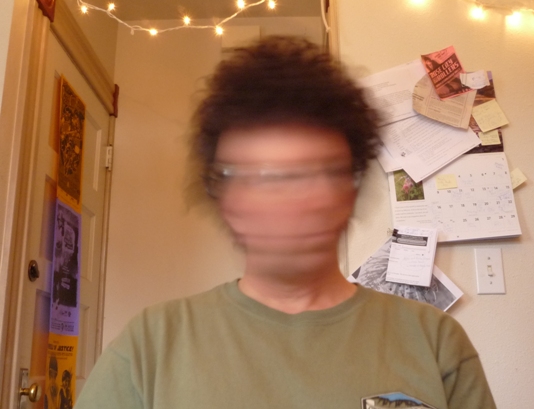
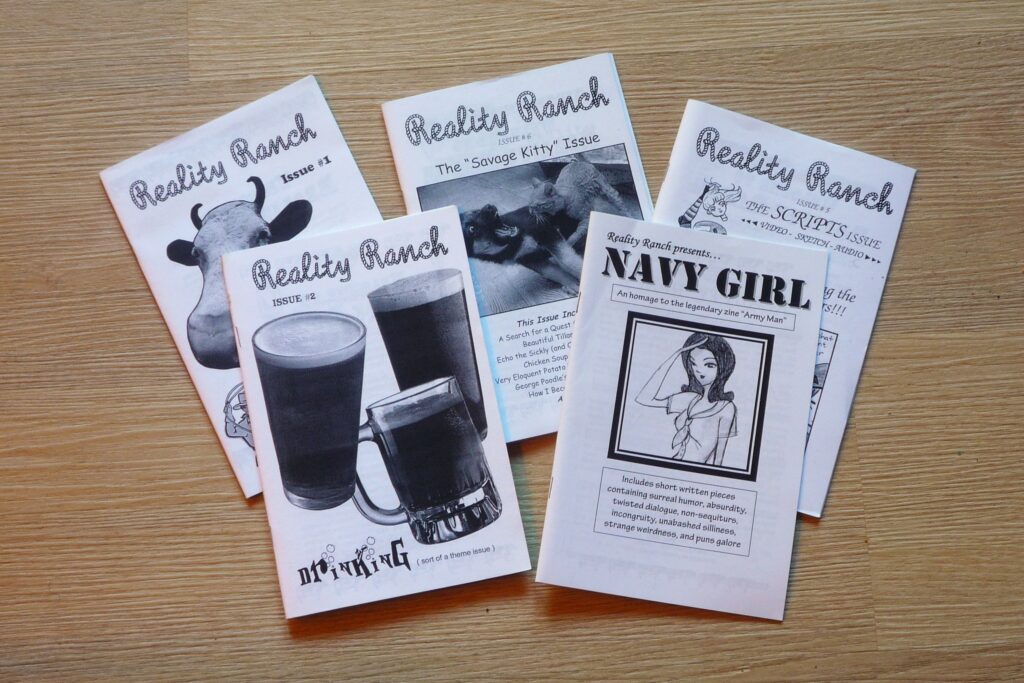
Scott Erickson’s humor writing covers the gamut: from short stories, to zines to novels. He honed his humor via his long-running zine Reality Ranch. Several of his funniest stories are expanded into novellas while his satirical novels include The Diary of Amy, the 14-Year-Old Girl Who Saved the Earth, Invasion of the Dumb Snatchers and The History of the Decline and Fall of America. Find his shorter pieces published in The Oregonian, The Portland Mercury or The Navy Girl Book, a collection of short absurdist humor. Someone must have found him amusing, as he’s won the Mona Schreiber Prize for Humorous Fiction and Nonfiction—twice. When he’s not writing, Scott enjoys rollerskating and beer (but not at the same time!).
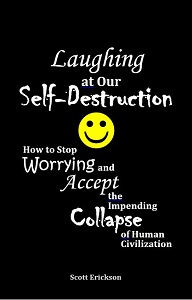
While writing novellas featuring giant slugs and teen zombies, the raging dumpster fire of humanity inspired his non-fiction book Laughing at Our Self-Destruction; How to Stop Worrying and Accept the Impending Collapse of Human Civilization.
Interview with Dark Humorist, Zinester, and Novelist Scott Erickson
KB: I’d love to hear more about how you got started as a zinester, before the publication of your first book. What inspired you to make zines? Did you feel like humor was something you needed to inject into Reality Ranch to draw attention to the topics you wished to address? Or is it just that your style of writing happens to lean towards humor regardless of the topic?
Scott: When I started exploring the idea of being a humor writer, I had no idea what form that would take. What style? What format? Essays? Short stories? Also, I had no idea of what my comic “voice” was. This was around the time that zines were a big phenomenon, and it seemed like a perfect way to experiment with all of this. Some of the pieces were specifically trying to emulate certain humorists I really liked. Woody Allen, S. J. Perelman, Dorothy Parker, Dave Barry.
How many would you print to start out, and how did you grow that? Did you just carry them with you everywhere, or did you make a tangible effort to distribute them?
Scott: I didn’t really try to market the zines. Mostly I gave them to friends and acquaintances, looking for honest feedback. My bartender friends really liked them to read during slow nights. There weren’t really any zines specifically devoted to humor, although some of them had comic elements.
KB: I have read so many zines, but they were all very serious. I’ll never forget the hand-drawn pamphlet urging people to squat to poop. It was no laughing matter. Are there other funny zines that you have encountered?
Scott: I still have a copy of a one-off zine called Coffeehouse Crushes that makes me laugh every time I read it. I also got my hands on a rare copy of Please Don’t Kill the Freshman by Zoe Trope, before it was expanded into a book. A lot of it is hilarious, although she didn’t intend it to be. But my most important zine discovery was the legendary Army Man, the short-lived zine by George Meyer, before he joined the original writing staff for The Simpsons. The zine included contributions by comedy friends who went on to great fame, such as Bob Odenkirk, with Mr. Show.
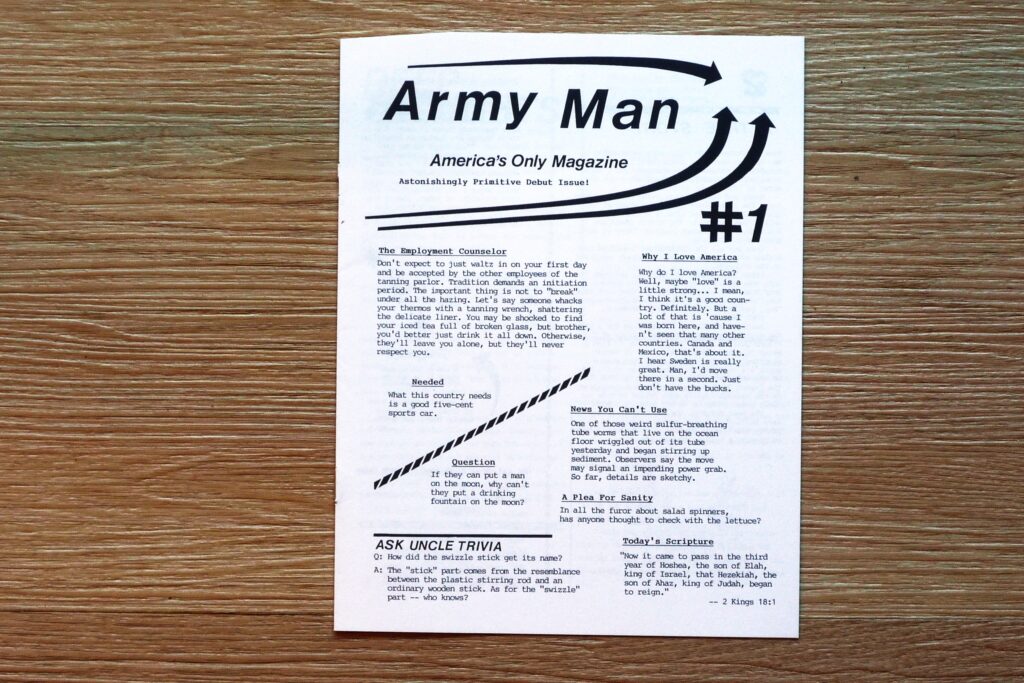
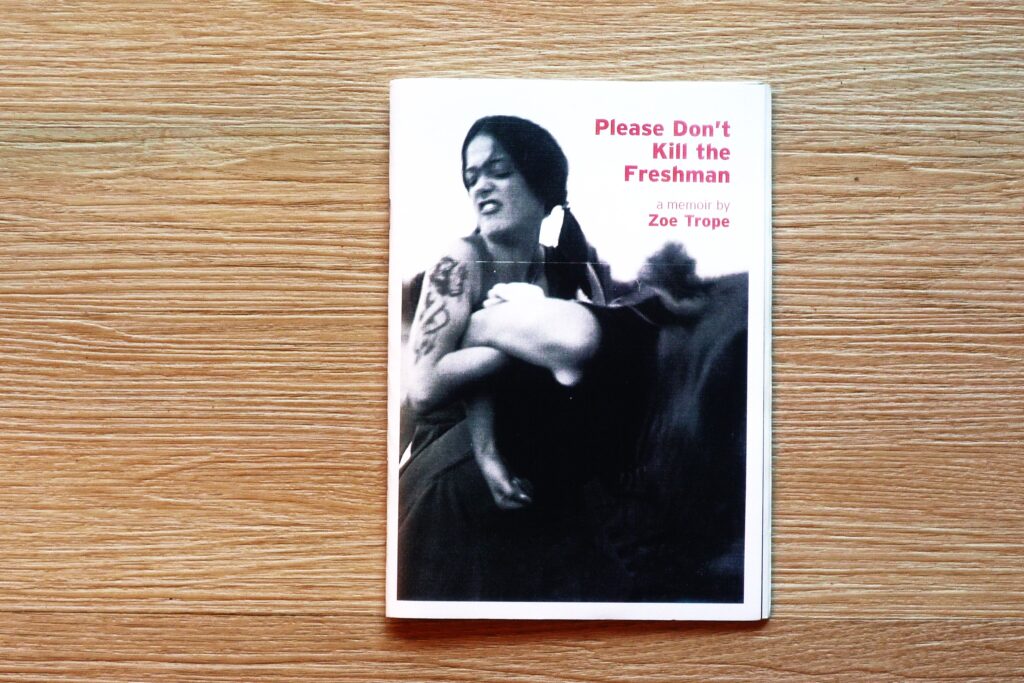
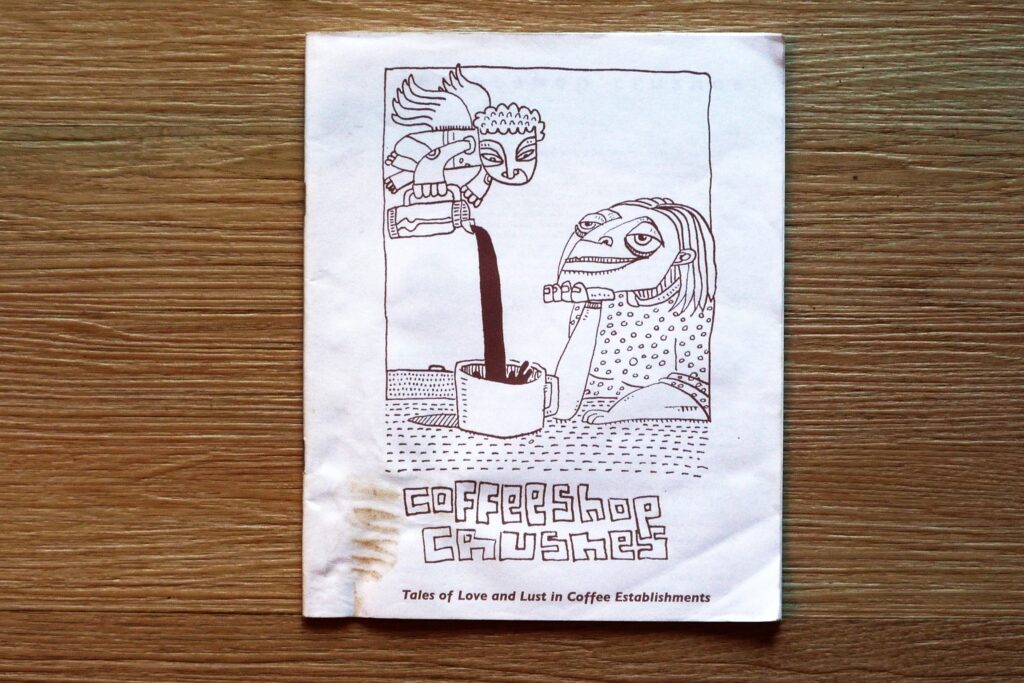
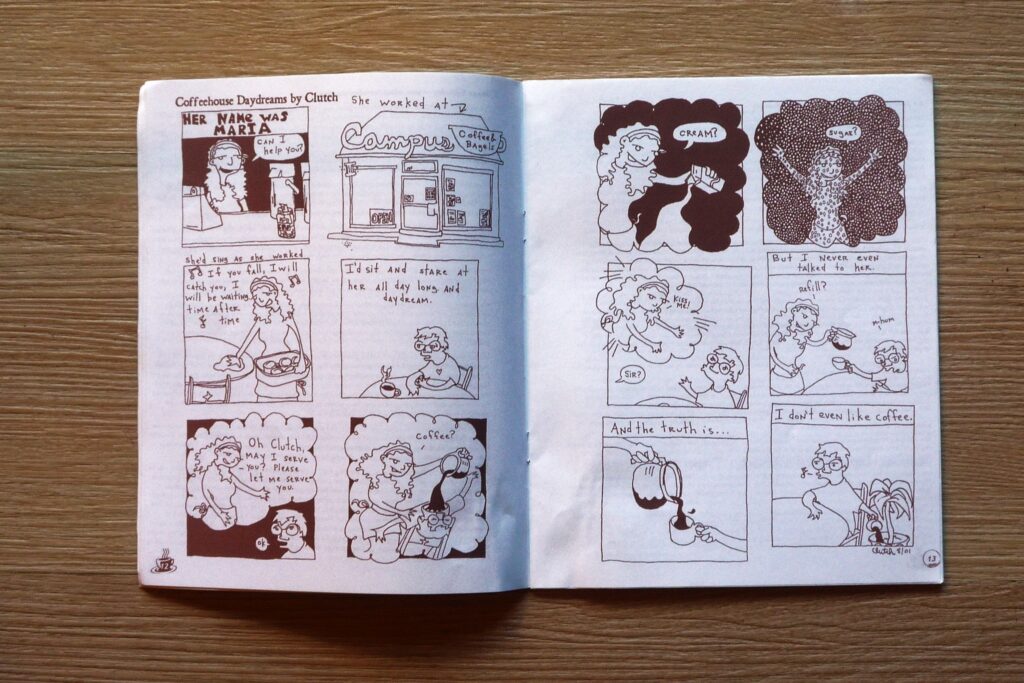
And Jack Handy, who went on to write the Deep Thoughts sketches for Saturday Night Live. I absolutely loved the style of the pieces in Army Man—short, absurdist, surreal humor. It was the only time in my life I’ve analyzed jokes—studied them to see what made them work. I tried many pieces in that style in an issue of my zine, which eventually led to my book Navy Girl—a homage that only extreme comedy nerds understand.
KB: What is the quintessential example of dark comedy that got you interested in writing this genre?
Scott: I don’t know about a quintessential example, but I’ve been inspired by dark comedy way before I was interested in being a writer. Way before I even knew what dark comedy was. I’m thinking of the Marx Brothers movie, Duck Soup—which as a kid I watched over and over. Long before I understood it to be a satire or dark comedy about war and nationalism.
KB: The subtitle of your book references Stanley Kubrick’s 1964 movie Dr. Strangelove. Or: How I Learned to Stop Worrying and Love the Bomb. You were inspired by Kubrick’s darkly comic approach to the terror of nuclear Armageddon, but your book confronts the impending collapse of human civilization. What does that process look like for you as a writer? Do you outline first a basic plot and then try to punch it up and make it more absurd? Or do you look at particular issues and try to think of a funny twist on them?
Scott: That’s an interesting question, because of something that a lot of people don’t know about Dr. Strangelove. It wasn’t originally meant to be a dark comedy. It was adapted from a very serious book called Red Alert, and was intended to be a serious movie. But, as Kubrick explained later, he had to keep leaving out things that were absurd or darkly comic. At some point, he realized that ramping up the absurdity and humor made a more powerful impact.
As for Laughing at Our Self-Destruction, a lot of the chapters began years earlier as serious essays—hoping to reveal the roots of our problems. Most importantly, in my opinion, our addiction to economic growth. But I had a very hard time finding anybody interested in publishing them. And it wasn’t just me. Other writers—much more qualified than me—were also trying to communicate the same things, with not much more success than I was having. Eventually I realized, as others had realized, that the world doesn’t want solutions. For a while I was very depressed about this. Later I realized, as a fan of dark comedy, that this was gold: A world full of experts, desperately wanting to advise the world on how to create a sustainable society, and the world’s response is, “Don’t let the doorknob hit you on the way out.” Which led to my decision to use the material as a basis for a dark comedy. The process wasn’t complicated: Just look at each particular issue, and search for how to spin it into satire.
KB: Are there dark comedy works that you feel particularly resonate with your particular background or identity? How have these inspired your work?
Scott: The style of Laughing at Our Self-Destruction was influenced by an Irish Writer Flann O’Brien, who, unfortunately, most people have never heard of. He also wrote a newspaper column under the pseudonym Myles na gCopaleen called “Cruiskeen Lawn,” which nobody has heard of. It was full of loopy, meta, self-referential humor, with random characters popping into the column to argue with the author. Which is definitely a technique I used in my book.
KB: Who are your favorite comedians? Are there any jokes, bits or specials in particular that resonate with your dark humor? Have any of these comedians influenced your work, and how so?
Scott: My all-time comedy hero is George Carlin. He was much more than a comedian, he was more like a social commentator. I think of him as a kind of philosopher. One of the very few comedians not afraid to show that he was intelligent and well-read. Yet he was also deeply hilarious. His routine “A Modern Man” is one of my favorites that I share frequently. I don’t think he was a direct influence in terms of style – I don’t think I could write in his style, anyway. Plus, stand-up routines don’t translate well to print, in my experience. His influence was more in the sense of: you can more easily address the darkest topics using humor.
KB: Just last night I watched his Ten Commandments bit. Hearing Carlin talk about his process, how much he considered the flow of the words; he is like a poet in his delivery.
Scott: I agree! His routine “A Modern Man” is more like poetry than comedy!
KB: What are you watching or reading lately? How does it inspire your writing?
Scott: Just started Harold by Steven Wright, the stand-up comic. It’s hilarious, and uses his stand-up style in a novel format. I recently finished Shit, Actually, by Lindy West. It’s a hilarious compilation of reviews of bad movies. Outrageous, over-the-top humor. I just re-read (for the third time?) the novel The Sellout by Paul Beatty. It’s a great satire about racial relations in America. If only I could write something so brilliant and hilarious in my life. I hope that such books inspire my writing, but I don’t try to let them influence my own style. They just inspire me to be better, funnier, sharper. I don’t want to try to follow anybody’s style. For that reason, I don’t read any humor or satire while I’m writing, because I’m afraid that I might unconsciously imitate them. Fortunately, I’m on a bit of a writing break so I can indulge.
KB: Your most recent publication is in the literary humor magazine Defenestration. Thank you for turning me on to this gem of a magazine! The word “defenestration” always reminds me of Defenstration, an art project attached to a building in San Francisco. Have you heard of it? I think they tore it down but for a long time it was an architectural work of art with furniture hanging off the side, like a Disney cartoon come to life.
Scott: I did an image search for the Defenestration Building, which I’d never heard of. I LOVE it. I’m a huge fan of the old Looney Toons cartoons, so that kind of stuff really does it for me. Last week I convinced my local bar to do a movie night with “Who Killed Roger Rabbit?” Which for Looney Toons fans is golden. So many references, many of them obscure and only hard-core fans would get.
KB: I absolutely adore Who Killed Roger Rabbit! An underrated classic. I’d never considered it dark comedy even though some of the scenes are very dark, like actual nightmare fuel. But now I must absolutely insist that you see I love Boosters! It takes that zany Looney Toons style and uses it to talk about the consequences of the endless growth of capitalism. If you do not love it, I owe you a dollar. You could probably still catch it in the theater if you hurry, As cinema–as a piece of colorful art—it’s absolutely something to see on the big screen.
I’ve heard O’Brien’s novel At Swim-Two-Birds inspired you to write the magical-realism fantasy Icons Are People, Too. But you also say you try not to imitate the voice of other humorists. What did you pull from in this work to write Icons are People, Too? Without imitation, how does influence play out for you?
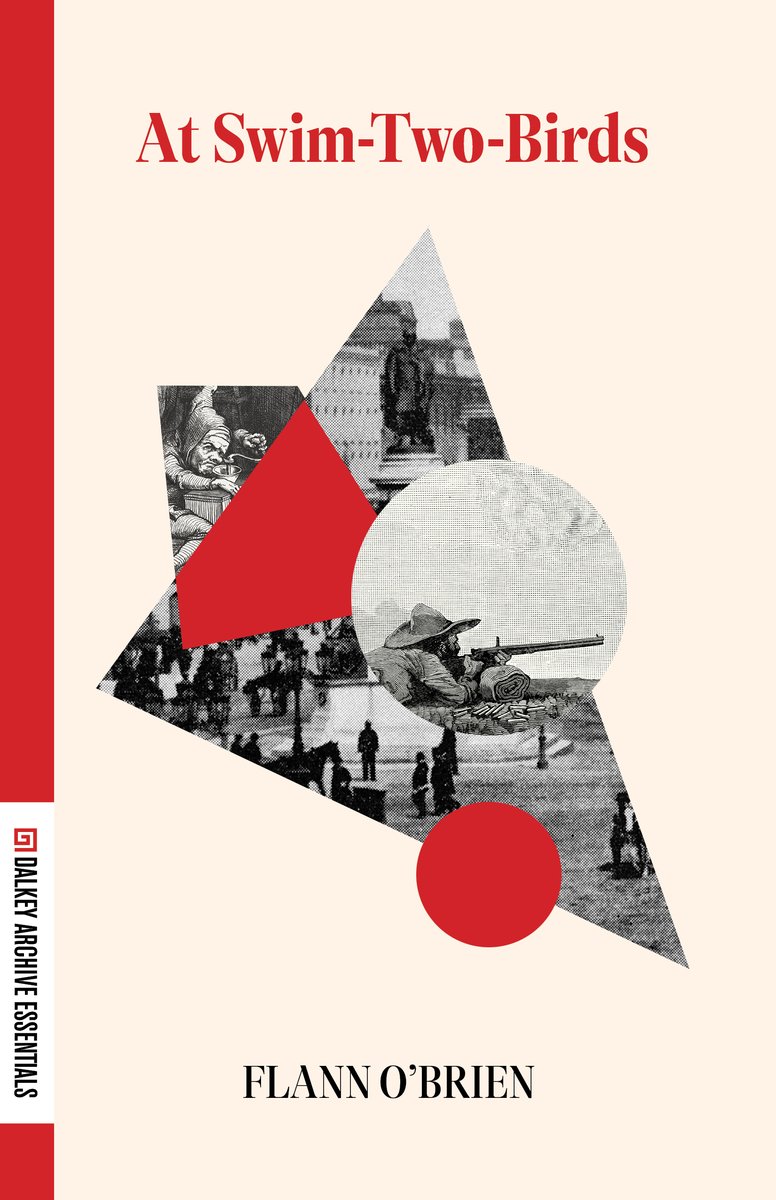
Scott: I loved At Swim-Two Birds. It’s one of the first postmodern novels, an early example of metafiction. I love meta-based humor. At Swim-Two Birds takes metafiction to an extreme. It’s about an author who begins three separate stories using characters from Irish mythology, but the characters leave their stories to interact with each other. They begin to disagree with the author, and one of them starts writing their own competing novel. Then the characters conspire to overthrow the author. I wanted to do something similar, and played around with a lot of ideas until one finally stuck. Instead of characters from Irish mythology, my characters were American icons—who are definitely mythological figures. I used Elvis, Marilyn, Janis Joplin, and Kurt Cobain. It was fun to throw them all into a dive bar, which provided great comic possibilities. As with At Swim-Two Birds, I had them rebel against the author. Specifically, against the screenwriter who was writing them into a horrible movie.
KB: I love it! I also love meta humor. My favorite comic artist is Jhonen Vasquez and one thing I love about his work is that he makes lots of snarky little comments in the margins of his art. He also has a character “Filler Bunny” that wants to die but lives for our amusement, begging the reader to let his suffering end. It’s a commentary on “filler” writing, but so much more interesting because the accusation is directed at the reader, who is usually a passive observer.
Satire is an important aspect of dark comedy. How have satirical works inspired you? Are there elements of satire in your writing?
Scott: I’ve definitely been inspired by satire that includes dark comedy. Such as Kurt Vonnegut. But the thing about satire is that I’ve always thought that satire needs a specific target. Such as government, corporate culture, political ideologies, etc. But I don’t know whether somebody like Vonnegut has a specific target. Obviously, with Slaughterhouse Five the target was war. But overall, the “target” of his work seems to be intangible. At least to me. It’s more like his target is all humanity. Or at least, the small-minded, selfish aspects of humanity. As for Laughing at Our Self-Destruction, I feel in a vague way that it’s a satire. But I can’t seem to come up with what exactly the target is. Maybe the same thing as Vonnegut?
KB: I just reread Mother Night, one of his more serious novels. In that book he’s very much targeting the idea of being a good person “inside,” arguing that your actions are what make you who you are, regardless of good intentions. So he’s thematically targeting a kind of person or a kind of thinking…which seems too ambiguous at first, but really that’s just because there isn’t a given name for what he’s targeting. Perhaps that one’s not satire, but the point stands. The movie Don’t Look Up comes to mind (probably because it deals with similar themes as your book). That movie is satirizing the way the world is responding to climate change. It’s clearly satire, the target is clear but we don’t have a word for people who ignore a crisis.
Scott: I don’t have a word either! But there should be.
KB: I have thought of satire as making fun of, but always punching up. Who would you like your writing to poke fun at? Even if you can’t put it into one word!
Scott: Don’t Look Up was such a brilliant satire. Because the comet that was on course to destroy the earth could be a metaphor for so many things. Most people took it as a metaphor for climate change. It could also be a metaphor for our addiction to economic growth—my candidate for the most important issue we refuse to examine. But my favorite part of the movie was the character of the billionaire, which I assume was patterned on Elon Musk. That was somehow the most hilarious yet also the most frightening part of the movie. Because people like that have taken over the government, dictating what public policy should be. We overlook that at our own peril.
KB: How does dark humor work as a coping mechanism for you, or for your audience?
Scott: My hope is, as with Dr. Strangelove, a way to use dark humor as a way to cope with a reality that’s too much to deal with. And unfortunately, there’s a growing number of people considering that maybe our civilization is not just going through a crisis, but is on a downward spiral toward collapse.
There are a growing number of websites and social media groups devoted to the topic.
KB: Oh, you’re on Reddit too? I’m mostly teasing about being a stereotypical redditor, but it’s wild, the stuff I see on /r/collapse or /r/climatechange that doesn’t even make it into the regular news feeds.
Scott: A lot of books are taking the topic seriously, such as Collapse by Jared Diamond. How does a person go on with their daily life if they’re convinced that we’re doomed? My book is for an audience of such people.
KB: That reminds me of Bo Burnham’s Inside. I really feel like it captures the zeitgeist’s slow-growing horror about collapse. Especially for Gen Z doomers. I have cried listening to “Welcome to the Internet.” And he drops in these little dark references. Especially the song “That Funny Feeling,” where he says “Twenty-thousand years of this, seven more to go.” It’s a really funny song that ends with the “quiet contemplation of the ending of it all.” My younger friends said they felt really seen and understood and laughed with relief, while my older friends were like, “WTF? Is this even a comedy special? It’s so dark.”
Scott: There is something from my book’s conclusion, which isn’t funny at all. It’s extremely sincere, and I’ve shared it with many people. It’s my idea of the best way to cope with our situation: “In the midst of a dying, life-defying culture hell-bent on self-destruction, how can I retain a positive attitude? How can I stay optimistic and happy? It may sound counter-intuitive, but the best way to cope with a life-defying culture is to affirm life to the best of your abilities. In the big picture, we’re doomed. So focus on the little picture. Focus on the differences you can make in your personal world. Add something life-enhancing to every moment. Make every interaction as life-affirming as possible. Leave every situation better than you found it. Add insight. Add humor. Add whatever the situation calls for to make it more alive, to make it a more genuine expression of life. If you allow humanity’s downfall to destroy your capacity to affirm life, then the bastards have won. Don’t let the bastards win.”
Learn more about Scott Erickson and his writing at scott-erickson-writer.com.
Scott Erickson’s latest book is LAUGHING AT OUR SELF-DESTRUCTION:How to Stop Worrying and Accept the Impending Collapse of Human Civilization.
YOU’RE NOT CRAZY!
Do you suspect that humanity is doomed, and are looking for confirmation that you’re not losing your mind? The good news is that you’re not crazy!
We can deal with quite a bit if we understand the reasons for it. This book will allow you to understand why there’s not a chance in hell that we’ll avoid the impending collapse of human civilization.
If that makes you sad, don’t worry. Because accepting that we’re doomed will allow you to stop worrying and laugh at our self-destruction
Azaria Press
ISBN: 979-8-218-82934-6


Leave a Reply